March 25, 2026
The Monceau Model 01 presents an interesting case study in modern watch engineering, prioritizing specific technical trade-offs to achieve its design goals. The selection of a manual-wind caliber is fundamental to its architecture, enabling a slim profile without compromising durability metrics. This analysis will deconstruct its core specifications, from case geometry to movement regulation.
Case Dimensions and Architecture
The Model 01 is constructed from stainless steel with a case measuring 39mm in diameter, 44.7mm lug-to-lug, and a notable 10.2mm in thickness. This thinness is a direct result of its movement choice. The case geometry is predominantly angular, with sharp transitions between its crisply brushed surfaces and polished bevels. This precision extends to the bracelet, where internal link bevels are also polished. A box sapphire crystal extends 1.8mm above the bezel, adding to the vertical profile while providing superior scratch resistance. The bracelet employs a quick-release system at the 20mm lugs and integrates a push-button micro-adjustment mechanism within the clasp for precise sizing.
Movement and Performance Specifications
At its core is the Swiss Sellita SW210-1, a handwound movement operating at a frequency of 28,800 vph (4 Hz). This caliber provides a 42-hour power reserve and is factory-regulated to an accuracy of -/+7 seconds per day. The choice of a manual movement over an automatic is the key enabler for the case’s slender dimensions. Despite its dress-adjacent profile, the watch features a screw-down crown, a critical component in achieving its substantial 200-meter water resistance rating, a specification not commonly found in watches of this type.
Materials and Dial Components
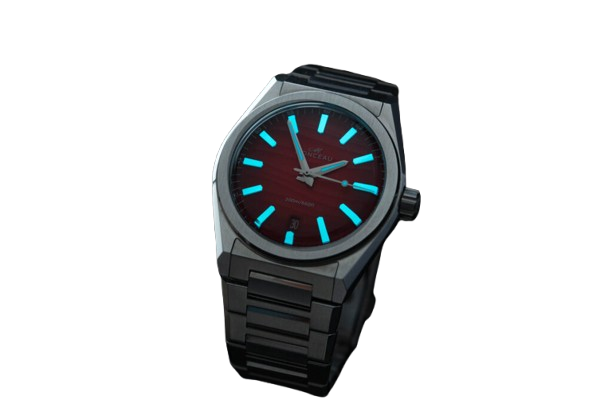
The dial is distinguished by a three-dimensional contoured pattern. For illumination, Monceau opted for solid blocks of Super-LumiNova for the hour indices, a method that provides significant luminous mass. The dauphine hands, however, utilize a traditional lume application. This results in a noticeable differential in lume intensity between the elements. A color-matched date wheel is positioned at 6 o’clock. Both the primary crystal and the exhibition caseback are fabricated from sapphire, ensuring durability and a clear view of the decorated movement.
In conclusion, the Monceau Model 01’s technical value is centered on its successful integration of a slim manual-wind caliber within a robust, highly water-resistant, and sharply finished case. The timepiece represents a series of deliberate engineering choices that prioritize a slender profile and high-performance specifications over the convenience of automatic winding.
#MonceauWatches #Sellita #SW210 #WatchEngineering #Horology #TechnicalReview #WatchSpecs #ManualWind