April 7, 2026
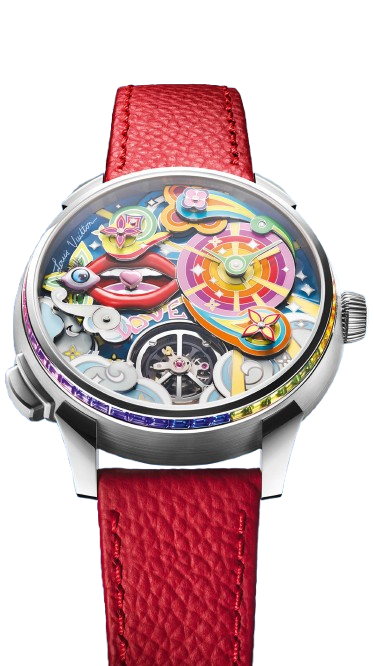
The Louis Vuitton Tambour Taiko Arty Automata represents a significant technical undertaking from the brand’s Geneva-based manufacture, La Fabrique du Temps. Beyond its divisive aesthetic, the timepiece is a showcase of complex mechanical engineering and advanced material science, integrating a high-complication movement with demanding artisanal techniques. This analysis will deconstruct the core technical specifications and craftsmanship that define this unique horological creation.
Case and Dimensional Analysis
The foundation of the watch is the Tambour Taiko case, executed in 18k white gold with a substantial diameter of 42mm. A notable feature is the gem-setting on the bezel’s outer periphery. It utilizes a full spectrum of baguette-cut rubies and sapphires. This lateral placement is a deliberate engineering choice, designed to provide the brilliance of gem-setting without visually distracting from the complex dial when viewed head-on. This approach preserves the integrity of the primary display while adding significant material value and complexity to the case construction.
Engineering the Caliber LFT AU05.01
At the heart of the Arty Automata is the in-house developed caliber LFT AU05.01. This automatic mechanical movement operates at a frequency of 4Hz and provides a power reserve of approximately 48 hours. Its architecture supports several key complications: an off-center display for hours and minutes, a flying tourbillon, and a sophisticated automata system. The automata function is user-activated via a pusher, initiating a choreographed sequence of animations on the dial. A unique structural element is the tourbillon bridge, which has been machined into the form of a peace sign, a feat requiring high-precision manufacturing.
Dial Composition and Material Innovation
The dial is an intricate, multi-layered assembly that requires an estimated 250 hours of labor to complete. The base components are hand-engraved gold, which are then meticulously decorated with hand-painted enamel. This process involves multiple firing stages to achieve the desired depth and color stability. The construction also incorporates unconventional materials, such as the use of minute bird feathers to form the eyelashes on one of the animated figures. This level of detail extends to the automatic rotor, visible through the sapphire caseback, which is also adorned with intricate enamel painting.
In conclusion, the Tambour Taiko Arty Automata is a technically ambitious piece. Its value proposition is rooted in the successful integration of a multi-complication movement with extremely labor-intensive artisanal crafts. It stands as a testament to the vertically integrated capabilities of La Fabrique du Temps, merging traditional high horology with modern material execution.
#LouisVuitton #Tambour #HauteHorlogerie #Automata #Tourbillon #Watchmaking #LaFabriqueduTemps #TechnicalAnalysis